Why raising your voice does not work
A louder voice works for seconds and costs the leader more than the group. The group learns that action starts at a shout, so it waits for one longer and longer. After a few sessions you have to shout louder to get the same result.
Attention is the effect of a clear system, not of volume. Groups respond to what they know and can predict. That is why work on attention starts with one signal, not with another command.
One signal instead of ten commands
The foundation is a START / STOP signal that the group learns in the first minutes and that never changes its meaning.
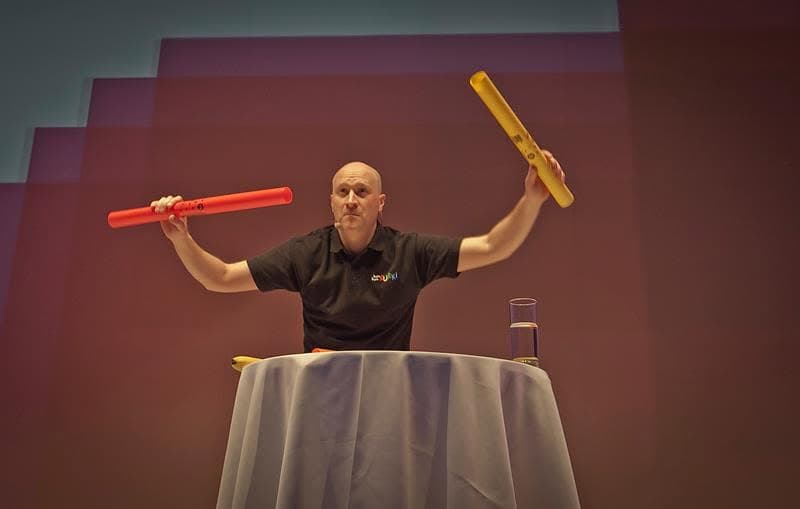
- The signal must be one and always the same, for example raising a tube or two claps.
- STOP always means a full stop, silence, not slower playing.
- Introduce the signal in the first minutes and practise it as a game, who reacts fastest.
- Do not count to three in different ways, the number and the method must always be identical.
- Appreciate fast group reactions, because the group repeats what gets noticed.
How to choose your signal
There is no single right signal, there is a signal that fits your group and your room. A few criteria that make the choice easier.
- Short and unambiguous, recognisable in a split second even in noise.
- Performable by the leader anywhere in the room, including behind the group.
- Comfortable for you, because you will use it dozens of times per session.
- Different from everything that happens naturally during play, so there are no false alarms.
- Test it before the first session, for example at home, the signal has to be your habit, not your idea.
Rhythm as the frame of a session
The second pillar is the steady rhythm of the session, a repeatable order, opening, action, pause, closing. A group that knows the frame does not ask what comes next, because it knows. That saves the energy you would otherwise spend on organising.
Treat pauses as part of the rhythm, not as a break in work. The short silence after an exercise is the moment when the group hears what it just did. Without it, experience does not turn into an insight.
Two rituals for the start and the end
The opening ritual. The same short greeting and the same first sound at every session. It can be funny, the point is that it repeats. The group enters session mode before you finish your first sentence.
The closing ritual. One question at the end, what worked today, and one shared ending sound. The group leaves with the feeling of having finished something together, which makes coming back easier.
Attention across age groups
The rule of the signal is one, but expectations towards the group change with age and are worth calibrating realistically.
- Preschool, expect a reaction within seconds and count on repeating the signal many times per session, that is normal.
- Grades 1-3, add a playful element to the signal, who reacts most quietly, the group competes for calm, not for volume.
- Secondary school and adults, add the reasoning behind the rule, an adult cooperates with a system they understand.
- Everywhere, never discuss the signal at the moment you need to use it, talking about rules belongs to the opening.
Four mistakes that drain attention
These slips cost the most attention regardless of the age of the participants.
- Many instructions at once, the group executes the last one or none, so give one and wait.
- Changing rules mid-game, because the group stops investing attention in something uncertain.
- Talking while the group plays, an instruction during the game never reaches everyone.
- No ending, sessions that fade out teach the group that the next ones may not end either.
The first three minutes decide
Most attention is lost on entering the room, before the session itself begins. That is why I treat the first minutes as an investment, not a formality.
- Greet the group when everyone is already inside, not while people are still coming in.
- Introduce the signal immediately and practise it as a short game, not an announcement.
- Say how long the session will be and what comes at the end, a group invests attention more easily in a known frame.
- Do not start with administration, attendance and notices belong in the middle of the session.
What next
The rules from this article work on their own, and their power grows when you use them with concrete exercises. Tested games for shared attention are in the article Boomwhacker games.
If you would rather go through these techniques live with a trainer who works with groups all year round, see the teacher training and call.