Preschool children (ages 3-6)
A playful first encounter with rhythm and music. Simple echo patterns, dance, movement, and character stories like Bongo Banana that quickly focus young children's attention.
Rhythm, movement, and shared playing matched to the age and abilities of the group.
I lead music workshops that teach children cooperation and discovering music through play.
I have worked with boomwhackers since 2010.
Choose a workshop by ageAdd as preferred source on Google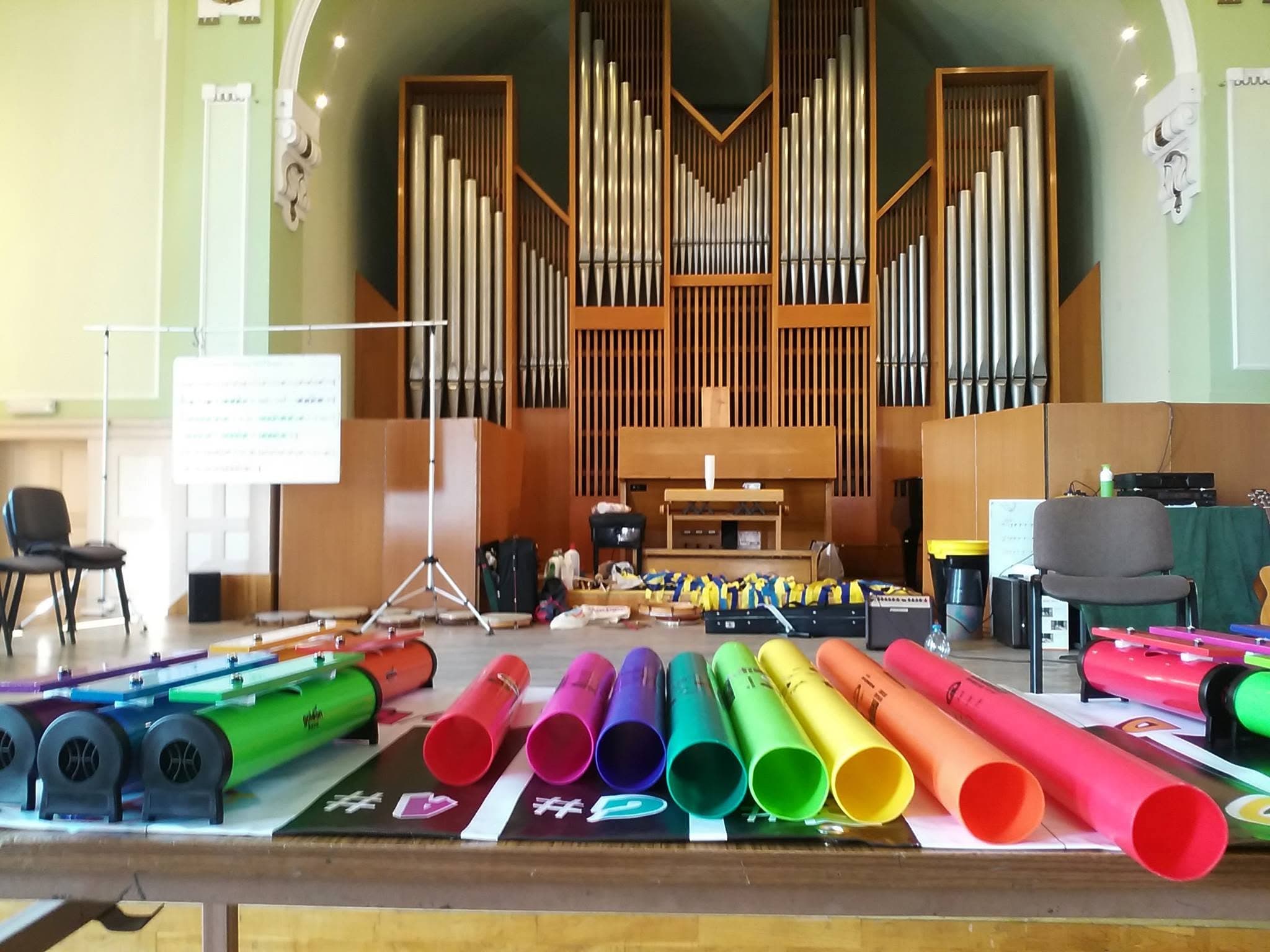 Colour, rhythm, and rules that help a group act together.
I match the workshop to age, group size, and the abilities of the children, with story-based sessions prepared for groups aged 3 to 14.
A playful first encounter with rhythm and music. Simple echo patterns, dance, movement, and character stories like Bongo Banana that quickly focus young children's attention.
A colourful shared groove, audio-motor coordination, cup games, and team rhythm challenges where children learn to listen to each other and play multi-part melodies together.
Advanced challenges and autonomy: beatbox fundamentals, rhythm coding with cards, student conducting, and collaborating on their own full musical arrangement.
I do not run one scenario for everyone. I match activities to age, group size, time, and venue.
We play rhythms, chords, melodies, and a colourful groove. Children learn to respond to a shared pulse and hear their place in the group.
Dance, action games, and partner challenges that connect movement with music and teach cooperation through play.
Every child becomes a character symbolised by the colour of their tube and receives a clear role in the shared performance.
We turn tubes into funny characters, look at music through imagination, talk about abstract ideas, and let the group create their own versions of the exercises.
Clear rules keep the session organised and let children enter the experience freely.
Every activity begins and ends with a clear conductor cue. Tubes are strictly for music-making, not for hitting others, and anyone who steps outside the rules takes a brief penalty break before jumping right back in.
We work at a tempo tailored to the group's natural energy. Caring for instruments and physical boundaries creates a structured environment where every child feels confident to participate.
Every session has a clear rhythm that I match to the age and energy of the group.
A short way into the group, an introduction of the session's characters, and clear rules so everyone knows what is coming.
About 55 minutes filled with prepared games: rhythm, movement, and action tasks, often requiring cooperation in pairs and teams.
The session closes with playing together or a mini performance the group can show to their teacher or parents.
The institution knows the conditions before discussing a date.
A gymnasium, hall, or large classroom with desks moved aside, allowing the whole group to form a circle, sit comfortably on the floor, and move freely to the pulse.
Sessions run with individual classes (ideally 20-25 children). This ensures every child holds their own instrument, receives personal guidance, and actively shapes the performance.
A designated contact person at the school or kindergarten who coordinates the schedule, group rotation, and aligns session times with school bells and breaks.
Three articles that show how I work with children and boomwhackers, before we agree on a date.
Why shared playing connects a group of children faster than a talking circle, plus a ready scenario for the first 20 minutes.
Eight tested games from warm-up to a mini performance, each with a clear rule, a duration, and a tip on what to watch.
How to choose a song, split the parts into colour groups, and lead a group into real music without reading notation.
The video shows a children's workshop, while experience since 2010 and the scale of teacher training provide wider context for the method.
Hundreds of workshops delivered in schools, kindergartens, and cultural centres across Poland, refined through live work with thousands of children of all energy levels.
Extensive practice with children combined with training education professionals, ensuring workshops follow sound pedagogical, developmental, and safety standards.
Click to see Dawid working with a group.
Timing, number of groups, venue, travel, and price depend on the agreed scope. All terms are discussed before confirmation.
Each workshop lasts around 55 minutes of dynamic music and movement play. During a single school visit, multiple sessions can run back-to-back across different classes.
I travel across Poland from Kraków with complete sets of instruments. For destinations over 150 km, travel logistics and arrangements are agreed individually.
The rate per child depends on the total number of participating groups and students on the day. Final budgets and dates are always confirmed directly by phone.
These answers help you check the fit before getting in touch.
Tell me what you need. Together, we will work out the format, date, and practical details.
I answer calls on weekdays from 9 am to 5 pm.