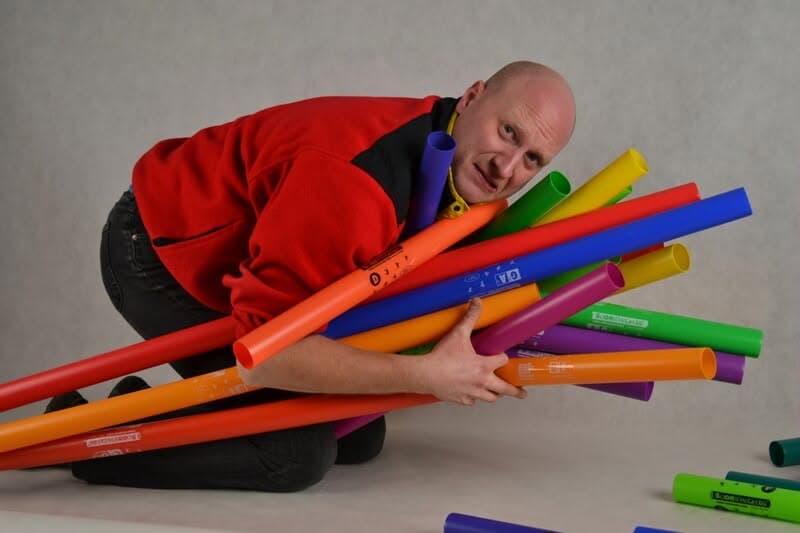
How colour replaces the note
In standard notation a player follows the staff. With boomwhackers a player follows colour. A tube of a given colour always represents the same pitch, so splitting a song into colours is also splitting it into parts.
This changes how you facilitate. Instead of teaching notation, you split the group into colour teams and show when each team enters. Players watch you and each other instead of a sheet, so the playing is shared and audible from the very start.
How to choose the first song
The first tune decides whether the group trusts the method. It does not have to be impressive, it has to be reachable.
- Short, with a chorus repeated two or three times.
- Well known to the group, so the result sounds familiar immediately.
- Built on two or three pitches, so two or three colours are enough.
- With a clear, even rhythm and no tricky tempo changes.
- Melodically in the middle of the scale, without the highest and lowest tubes.
Splitting the parts step by step
A simple, proven split into three groups looks like this.
- Step 1, play or sing the song with the group so everyone hears the whole before the split.
- Step 2, divide participants into colour teams, each holding one colour.
- Step 3, team one plays the base pulse, the most repeated tone of the song.
- Step 4, team two plays the chorus entries, on the highlighted syllables of the lyrics.
- Step 5, team three handles the accents, single strong hits in key moments.
- Step 6, play it slowly, fix the places that fall apart, and only then speed up.
The conductor, start, and pause
One person sets the tempo of a shared song. At the start of a session that is you, later you can hand the role to a participant, which is in itself an excellent exercise in responsibility.
The conductor shows three things with a tube, the start, the pause, and the ending. Two gestures are enough, raising the tube to play and lowering it to stop. Once the group knows the START / STOP signal from earlier exercises, the song can breathe without turning into chaos.
Three mistakes that ruin the first song
I see these most often when someone leads boomwhackers for the first time.
- Starting too fast, before the group knows its entries. Begin half as slow as your instinct says.
- Splitting into too many parts at once. Two colours are enough for the first tune, add the third in the second run.
- No listening pause. After the first run stop and ask which team heard its own role, then play again.
Variants for different groups
With preschoolers limit the song to the chorus and play without lyrics, two colours are plenty. In grades 1-3 use the whole song and swap roles between runs.
With older students and adults add a third voice and let the group propose its own ending. Corporate teams respond well to the task of composing a short entry for their own colour team.
If you want to walk through this process with a trainer who does it all year round, see the teacher training with boomwhackers, where we go from the first sound to a ready performance with a group.
After the first song
The first recognised tune is a turning point, not the end of the work. From that moment the group knows it can do this and is ready for the next challenge.
- Pick the second song at a similar pace but with a different colour split, so nobody stays locked in one role.
- Introduce card notation, a few colour cards on the floor that the group reads as the path of the song.
- Offer a shared performance, a school assembly or an open lesson for parents, an audience changes the level of commitment.
- With older groups let the teams split the parts themselves, it is the shortest path to real cooperation.
Materials and song rights
Working with tubes does not require special sheet music, a familiar melody and the knowledge of which colour holds which pitch are enough. Colour-coded arrangements are available online, and I am preparing my own method materials for publication.
Remember the copyright of the songs themselves, especially for public performances. Folk and traditional children's songs are safe, while contemporary hits need a licence check. Downloadable materials on this site will only appear once the rights are confirmed, because I do not publish anything I cannot share properly.