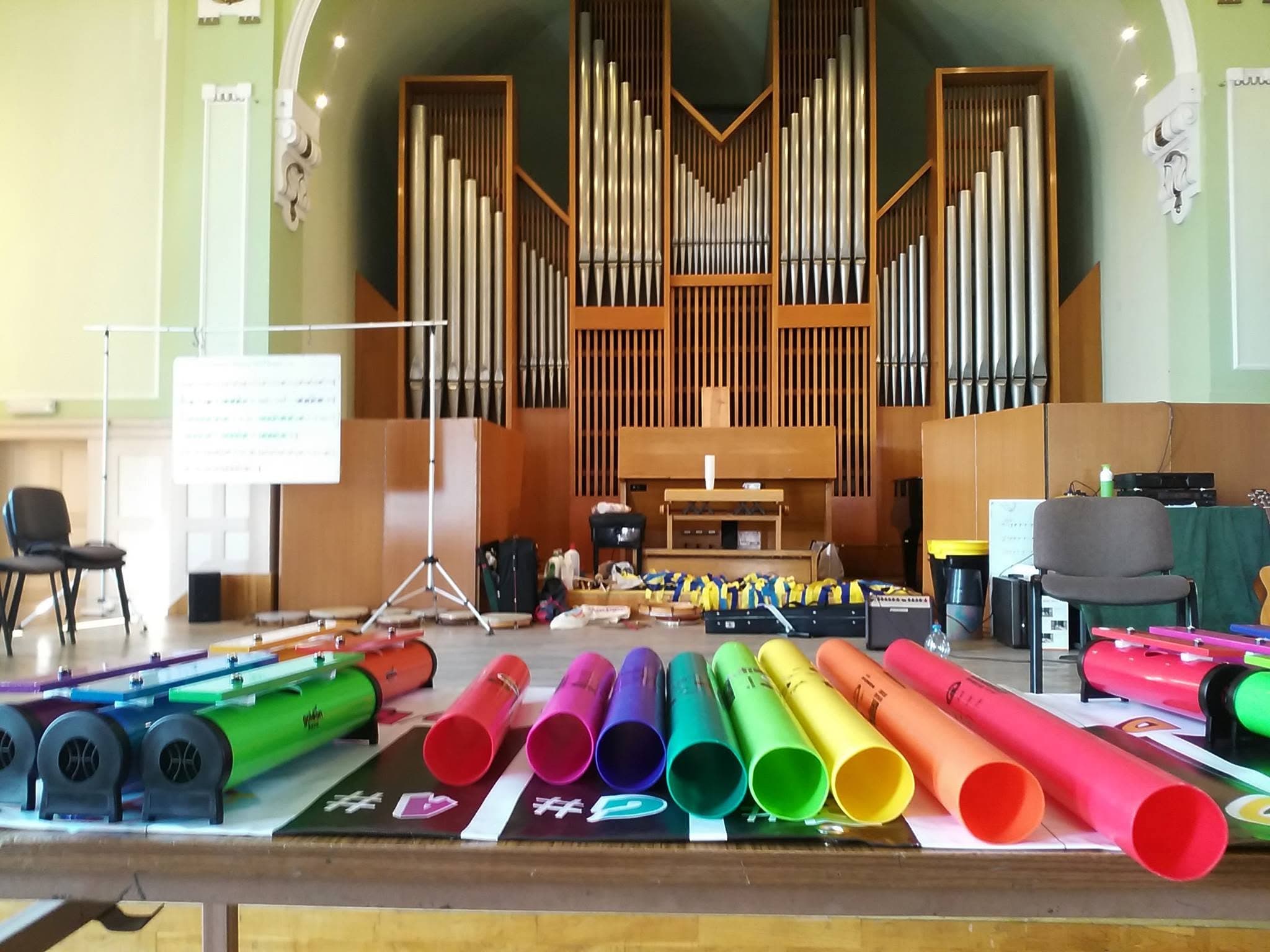
What boomwhackers are
Boomwhackers are plastic tubes of different lengths that produce a clear, tuned sound when struck against a hand, a knee, or a chair. The longer the tube, the lower the pitch. Together the set forms a real musical scale, not random noise.
Each length has its own colour, and colour is the key facilitation trick. Players do not read notation, they respond to the colour of their own instrument. Someone who has never played knows when it is their turn within two minutes.
- The tubes are tuned, so a group can play real melodies, not just rhythm.
- Colour replaces the note, which removes the barrier of reading music.
- The instrument is light and safe, from preschool all the way to adults.
- One tube per person is enough to start, though a full classroom set sounds best.
Why they work so well with groups
Boomwhackers lower the entry barrier to music almost to zero. Nobody needs to play, sing, or read music, yet within minutes the group hears a shared result of its work. That quick result builds trust in everything that follows.
The second strength is movement. The sound comes from motion, so participants strike, count, listen, and watch one another instead of sitting still. Active music sessions engage the whole body, which makes the tubes a great integration tool.
Finally, boomwhackers turn a group into an orchestra. Everyone holds one voice, and the piece only works when people listen to each other. It is the sound of cooperation, heard directly, with no explanation needed.
What you can do with them
The simplest start is rhythmic play for warm-ups and focus. Ready-made ideas are described in my article Boomwhacker games, with eight tested exercises from rhythmic echo to a mini performance.
The next level is playing real songs together. Colour groups make it possible without notation, which I describe in Boomwhackers songs.
Tubes also work outside the music room. With children they build integration through shared action, with adults they become a musical icebreaker for workshops and corporate events. In communication training I use them as a live material for observing DISC behaviour styles.
How to start at school or in a session
You do not need a full-hour plan, only a good first fifteen minutes. This sequence has worked for me with groups that had never held an instrument.
- Set the group in a circle and hand out tubes so that neighbours hold different colours.
- Introduce one START and one STOP signal, for example raising and lowering a tube.
- Play a rhythmic echo, the leader plays a pattern and the group answers.
- Split the group into two colours and play an alternating rhythm, your first shared piece.
- Close with a short talk about what the group heard when it played together.
What not to do at the start
Most disappointments with boomwhackers come from three habits that are easy to remove.
- Do not start with theory and note names, the group loses energy before it plays anything.
- Do not pick a tune the group does not recognise, the result must sound like success.
- Do not lead without a clear STOP signal, chaos quickly kills trust in the method.
- Do not force reluctant players into solos, give them an equal shared role in the circle instead.
How many tubes and which set to choose
For a first session one tube per participant is enough, and the simplest purchase is a diatonic set covering a standard scale. For groups of up to thirty, a classroom set works well, since it holds several tubes of each colour and lets you split the group into even sections.
Chromatic sets, with the additional flat tubes, only matter for advanced melodies and are not needed for group work. If the budget is limited, invest in colour variety before scale extension, because splitting into voices is what makes the biggest difference to how a group sounds.
Where this method comes from
I have worked with boomwhackers since 2010, from preschool games to large corporate events. Those years taught me one thing, the instrument is only a tool, and everything happens between people. The tubes are special because you can hear that human dimension directly, in every minute of shared play.
If you want to move on to specifics after this introduction, start with the eight games for active sessions, then continue with playing songs together. And if you would rather have someone who has done this for years lead the first steps with your group, call, the number is in the footer, or see the teacher training.